Rosemary's January Party
Rosemary's BabyRosemary's January Party is a gathering Rosemary Woodhouse plans for January 22, but its decisive action is not the menu or the guest list: it is the moment her friends learn how much pain she has endured and urge her to consult another doctor. Their questions make visible a conflict that her husband, Guy Woodhouse, has tried to contain within the authority of her existing physician. When Rosemary resolves to seek a second opinion, her pain abruptly disappears, leaving the promised consultation unfulfilled in the immediate scene and the underlying concern unresolved.
Planning and Boundaries
Rosemary announces the party to Guy while she is copying a recipe from the Life Cookbook. She gives the date as January 22, a week from the following Saturday, and lays out an extensive invitation list: Elise Dunstan and her husband; Joan and a date; Jimmy and Tiger; Allan and a date; Lou and Claudia; the Chens and the Wendells; Dee Bertillon and a date; Mike and Pedro; Bob and Thea Goodman; the Kapps; and Doris and Axel Allert. She identifies Doris as Hutch's daughter. The detail of the list presents the party as a deliberate act of arranging and reconnecting, not an impromptu visit.
The invitations also establish a boundary. Rosemary explicitly excludes Minnie Castevet, Roman Castevet, Laura-Louise, the Fountains, the Gilmores, the Weeses, and Dr. Sapirstein. Her rule that guests must be under sixty gives that boundary a light, social explanation, but the exclusions are concrete: her usual older circle and her doctor are not to attend. The gathering is therefore organized around Rosemary's own selection of company, even as its central conversation reveals how little control she feels she has over her medical situation.
Pregnancy Disclosed
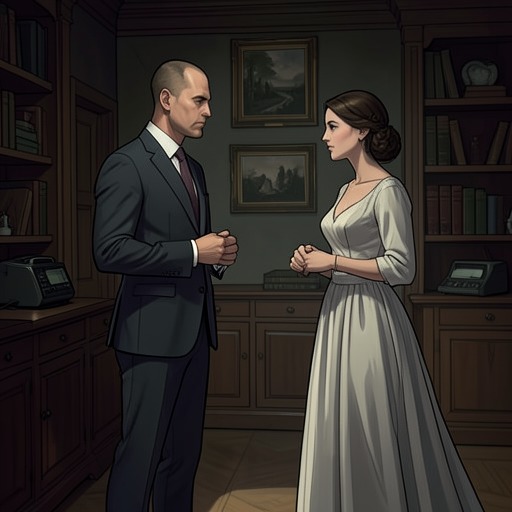
At the party, Joan draws Rosemary aside, looking frightened, and asks what is wrong. Rosemary answers that she is pregnant. The exchange changes the party from general sociability into a setting where her condition can be discussed openly. When Claudia has mentioned a cramp, Rosemary acknowledges that she has pain but assures her friends that it will stop soon and is not abnormal. Her reassurance is immediately tested by the questions that follow.
Rosemary eventually breaks down in tears, saying that the pain is severe and that she is afraid the baby will die. Elise asks whether the doctor has offered medicine or any other treatment. Rosemary says he has done nothing. That answer sharpens the difference between her private suffering and the confident account she has given of her care: she has pain that frightens her, yet no treatment has been provided. The friends do not treat her distress as a routine complaint to be dismissed. They ask what has happened and press her to consider another source of medical judgment.
Rosemary initially defends Dr. Sapirstein by pointing to his reputation and television appearance. Tiger calls him a sadistic nut, while Elise focuses on the practical issue: persistent pain should be checked, and Rosemary should see Dr. Hill. Elise frames the suggestion as a second opinion, not as a demand that Rosemary immediately abandon her doctor. Joan makes the proposal more definite by urging Rosemary to go first thing Monday morning. Rosemary agrees and promises to do so.
The Dispute over a Second Opinion
After the party, Rosemary tells Guy she intends to see Dr. Hill on Monday and wants him to examine her. She explains that Dr. Sapirstein must either be lying or be seriously mistaken; pain of this kind, she argues, is a warning that something is wrong. Guy responds by emphasizing the prestige of Dr. Sapirstein and belittling Dr. Hill. He also objects on financial grounds: they would have to pay both doctors. When Guy says she is not changing physicians, Rosemary clarifies that she is not announcing a change; she wants an examination and another opinion.
The exchange places Rosemary's stated need for reassurance and assessment against Guy's appeal to the established doctor and the cost of consulting another. Rosemary says the pain has been present since before Thanksgiving and that Dr. Sapirstein has repeatedly told her it would stop. The duration matters: what sounded at the party like a single episode is described at home as a continuing condition, while her doctor has provided neither medicine nor treatment. Guy's insistence that she will not change doctors does not answer that history. Rosemary persists, saying that if Guy will not pay, she will pay herself, then stops mid-sentence.
The Sudden End of the Pain
At that instant, the pain is gone. The abrupt change interrupts an argument that had seemed to be approaching a practical decision. Rosemary recognizes the relief and tells Guy that the pain has stopped. The sequence does not establish that the cause has been found or that the earlier suffering has been treated; it establishes only that the symptom disappears just as she asserts her intention to seek independent advice.
The party's consequence is therefore double. Rosemary has said aloud, in front of friends and then to Guy, that she is afraid for the baby and dissatisfied with the lack of care. She has also made a specific plan to consult Dr. Hill. Yet the sudden reprieve removes the immediate pressure that had driven the plan, without resolving the disagreement about medical authority or explaining the pain. In the event's structure, the relief is a reversal rather than a diagnosis: a social gathering opens a space for Rosemary's concern to be witnessed, but the promised second opinion remains a decision she has voiced, not an examination shown here.